Today we're going to recap Sunday's adventure. It's more of a tale about persistence and beauty than it is catching the data and subsequent fish. We'll do all the normal rundowns in terms of our atmospheric data and fish caught (yes, we still netted fish). Last, we're going to do something I promised last week - we'll give you a dashboard on fly selection for Spearfish Creek Browns. In addition, we've got a little data on the importance of water temperature.
Atmospheric Apocalypse
Looking at the weather and stream data, one should not be surprised that fish were tough to come by. As mentioned above, air temperature hovered between 15 and 17 degrees. Humidity was high as the snow continued to fall and turned the beloved Black Hills into a sea of white. I could spot fish in the creek, and it was clear they were in a serious holding pattern. Sitting in a couple distinct water columns, I knew my drifts had to go down the stream without a hitch. We'll get more into the importance of a good drift as we delve further into the series, but for now....just know you need a good one - that's not a total drag :). At any rate, I waited to test the water temperature until after I netted the first fish. Upon a successful release, I took a reading. 35 degrees was the water temperature. Thank god for snow pants and smartwool socks. Because for you greenhorns out there, 35 degree water is enough to put your body through a serious condition in short order. In other words, respect the water and its temperature. Not doing so could end your fishing day, and in some waters, your life. Needless to say, the weather was miserable. And for the first time in a while, I was pleased to hop out of the water and run errands for my wife. There is something to be said about the majesty of a new-fallen snow on the tall hills once inhabited by the Lakota in our sacred Black Hills. The way the big flakes kiss the earth and fill the streams offers a fresh perspective as to why we're here. All we have is time, and seeing things like this is what drives me as a fisherman.
Net Results
In the 180 minutes spent on the water, we pulled in 2 fish. Yes, 2. That's it. That's all. End of story. Or is it? This is a really good spot to segue into the dashboard - which really focuses on the importance of water temperature. We'll get to that in a minute. The couple fish I managed to put in the net weren't bad fish. The first, which had a very subtle take - measured at 16". This is a good fish for this section of Spearfish Creek. Our second fish was a shade over 14". So, while not surprised at having to work for the fish - I was pleased with the result. Both eagerly took a Frenchie I tied up. This is a special fly to me because of the color scheme. The collar of the fly is chartreuse in nature. So, it screams as it descends into the Brown Trout stomping grounds. Fish seem to dig it. Again, I stray from the point. The weather, lack of bugs on the water, and the generally terrible weather told me it was going to be slim pickins on Sunday. In the end, I had a great time....until I didn't :).
Data Dig
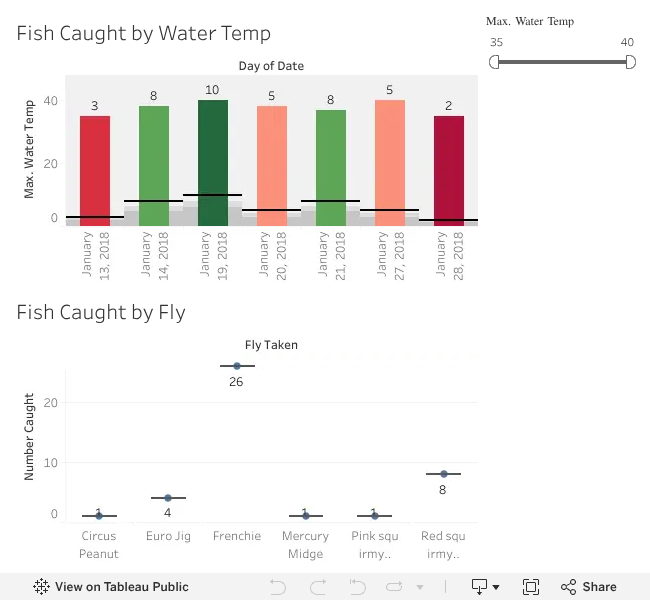
The charts below are going to shed some serious light on the importance of conditions when you're seeking to put fish in your net. Seriously, the data don't lie.
I want to first focus on the water temperature piece. Notice a trend here? Sure you do. Even though the sample is limited at this juncture, a distinct pattern of information is emerging as an important factor in how many hook-ups you're getting on the water. There is a certain evolution in fisherman, and it goes like this. First, it's just good to be out. Then it transcends into number of fish caught. From there we travel to being a "size king". We conclude at, "it's good to be out." I'm at a pretty adventurous stage in my fishing adventures. Ok, back to the point! 5 fish netted when the water dips to or below 35 degrees. 36 fish were caught when water temperatures were 37 or above. LIGHTBULB! So, all those warnings about water temp being important are true? Get outta town! Yeah, they are. And the data are telling you so.
Okay, the other thing you need to realize by looking at this dashboard is the fly selection. I'm no Tom Rosenbauer. In other words, unlike some, I don't fiddle with fly selection a lot. Taking the advice from Fly Shop bums passed on many moons ago, "fool with your rig first." Adjust depth and weight multiple times before messing with your flies. Now, this is probably personal opinion, but I think the results show I can be successful using a really basic setup. Approximately 65% of the fish I've caught over the the last few trips...were caught on one pattern. Another 22% were taken on another pattern. I've had great success keeping it simple. Bottom line, know what is on the menu for fish; however, know where they are sitting in the water. This enables you to toss pretty much any menu item at them....and pass it by in a way that they can't refuse it. Trout are opportunistic feeders, it's up to you to create the opportunity. It's the guy, not the fly sometimes.

Keep 'em wet,
MB

No comments:
Post a Comment