Tuesday, February 27, 2018

02/24-25/18 - Czech Us Out!

I've done my ample amount of complaining about the weather over the last month, but I finally feel as though the blanket of sub-zero temps and lazy fish is lifting on us. Our extended forecast in the Black Hills is calling for sustained temps in the mid-upper 30s over the next couple weeks. That means we'll be pretty active at The Emerger. The last month has been me chomping at the bit to get out a little more and really put some work in on the water. The demands of my real job haven't helped much, either. Then there's the responsibilities of being a father and a husband. Well, you get it - we're strapped for fishing time! I'm excited, though. This spring I will get to spend some real quality time with my daughter on the water. Ok, we're really straying from the point of the post. We are in full transition mode here. I'm going to talk a little about this and the regular rundown of things in this post. So, you'll see the regular data, results, and media. However, you're also going to see in the rig rundown a move to a different rig.... Dun-dun-dun... The foreshadowing is killing me. Let's just get to the point...

Czech Us Out - Euro TRIP! 

I've been mulling it for a while, but I finally made the leap to a dedicated Euro Style Nymph (ESN) rig. I must say, it's been a project in the making. I did this for a couple reasons. First, I'm a fairly "Type A" personality. Meaning I value things like efficiency, not wasting resources, and doing things as their designed to be implemented. I've fished with a strike indicator on my nymph rigs for a number of years now, and the idea of a more efficient and natural method enticed me. The fact that is was more effective when seeking to catch fish was an added bonus. Knowing kind of what I wanted, I stopped at one of my local shops, Dakota Angler & Outfitter, to see what they could hook me up with. The folks at the shop did a really nice job recognizing what I was after and gearing me up with a rig that would perform and last. I'm notoriously hard on gear - because I actually use the heck out of it. So, it was paramount to get a tough, sensitive rod that could be versatile, too. I'm more than happy with the purchase. We're getting away from the point, though. I am changing things up and will likely fish this rod in 80% of the situations I encounter. I was envious at the level of skill and ease Euro Nymphing exhibited on the water. That doesn't mean it's easy in application. There is a learning curve for us "dyed in the wool" indicator guys. From the setup to the hook-set, EVERYTHING is different. Just like anything related to fly fishing, though, you'll get it if you put in the effort. The same is true in life. I'm not going to spend this entire post gushing about ESN. It works, and it takes some getting used to. There's a silver lining, though.... There are several resources that help dampen the learning curve. From George Daniel's "Dynamic Nymphing" to Lance Egan and Devin Olsen's "Modern Nymphing", you'll find stuff that will help you out. And by diversifying and adding to your toolkit, you'll become a more well-rounded fisherman. Hell, you might learn something new, too. I'm going to link these in the additional resources at the bottom of the page.

Atmospheric Data:

Temps: Mid-20s on 02/24; Low 30s on 02/25
Water Temp: Between 30 and 33 degrees
Cloud Cover: variable with ample sun
Stream Conditions: Accessible with significant ice impact on sections of Spearfish Creek
Flows: Unavailable due to ice blockage

Bug Data:

We seined the water again to see what was swimming around for the fish to eat. There were plenty of midges and small scuds floating around in the stream on both days. This is the bread and butter for our winter fishing. So, we're rigging with zebra midges, scuds, wd-40s, and other flies to imitate the profile of midges and emergers. They're really effective on most days.

Rig Rundown:

Rod - Echo Shadow II (10' 3wt)
Reel - Echo Ion
Line - Rio GOLD
Leader and Tippet - 15' Hanak bi-colour and 5 - 10' of 5x tippet
Flies - Scuds and Frenchies

How'd We Do? - The Results

We got wailed on! Whether it was the weather, the new rig/technique, or my cold feet....I got humbled - big time. We netted a total of 6 fish in about 6 hours. This goes to show that with any new technique, there's a learning curve associated with it. It took me a while to understand how to lead the fly, feel for bottom, and most importantly - detect a take. The second day of fishing was considerably better, but it was clear (to me) that I was certainly no Devin Olsen when I got to applying the technique! It is so much fun learning how to do it, though. We used all the data we had to be successful on the water, and by some measures, we were. However, this goes to show that the old saying...."It's the guy, not the fly" definitely rings true. So, to help you not get a crap sandwich handed to you on your first day of ESN fishing...I present....(drum roll, please), additional resources. Seriously, check these out and make your time on the water more productive.

Additional Resources


Modern Nymphing - You'll have to buy this one, but it's worth it's weight in gold. Devin Olsen and Lance Egan walk you through EVERYTHING. 


 Dynamic Nymphing - A 3 part lecture given by the master himself, George Daniel. You'll learn more about physics and fishing than you ever imagined. If you want a good drift, watch it.


Red's Fly Shop on "Why Euro Nymphing Doesn't Suck - A quick and dirty on the style. I like Joe's videos, and he's super helpful with other techniques. Focus on the first two and you're golden. 


Fishy Media: 

As always, we're gonna close things out with a little fishy media. Hope you are having fun tracking my adventures, successes, and failures while fly fishing in the beautiful Black Hills. 


Keep 'em wet,
MB


Sunday, February 18, 2018

02/16-17/18 - Wonky Flows and Reprieve from Snows

It's been quite the winter thus far. As I sit and pen this blog tonight, the beautiful Black Hills is being blanketed by the majesty and fury of a February snow storm. In fact, the entire state of South Dakota is going to feel the burn of this one. We're expecting another 12" of the white stuff by tomorrow evening. For a relatively mild winter, we've received over 2 feet of snow in the past few weeks. Snow, melt. Snow, melt. It honestly feels like a Townes Van Zandt song, "Snowin' on Raton, by the mornin' I'll be gone." That's been the pattern as of late, but it doesn't mean we can't get out and use the data we have at hand to net some fish. I was fortunate enough to get out on Friday and Saturday to put my skills to the test. We'll go through the temp, water, and rig data in bullet format below, and we'll offer some more narrative as to the approach we took.

Atmospheric Data:
  • Air temp on Friday (02/16) was 38, Saturday (02/17) was 35
  • Water temp on both days was between 30 and 33 degrees
  • Section flows - City Park (02/16) 12 cfs, City Park (02/17) 55 cfs, North Hwy 85 (55-60 cfs)
 Rig Rundown:
  • Echo 3 wt
  • Lamson reel
  • Rio line
  • Rio leader and tippet 5x
  • Lead fly: Umpqua Euro Jig; Dropper: RADiation Scud, Scud
 Everybody's Workin' for the Weekend!

Everyone likes Loverboy, right?! Yeah, we were certainly workin' for the weekend. So,we're going to get started with Friday, naturally. I was out pretty early that day - around 11am. I should note that I only fish when our children are napping. So, I'm pretty limited in what I can and cannot do when it comes to getting out and putting the work in. My motto is to make use of the time I have in order to feed my passion. When I arrived at the creek on Friday, I noticed something really strange. The creek was flowing really slowly. Checking RiverApp, I noted that the stream flows in the particular section I was fishing were WAY down. To be clear, they went from around 55cfs on Thursday to 12 cfs on Friday at 11am. This means that the stream was barely flowing. The section I was in is controlled by the USGS, and sometimes they alter the flows without any notice. Also, as an aside, I suggest downloading RiverApp through the link above. It pulls all USGS data for stream flows, and it will let you know what to expect from your local watershed. Anyway, we got into our first pile of fish relatively early. The onslaught continued from there. We were pulling them in left and right near the city park. Size wasn't a consideration when fishing this section. It's just good to hook up. When I was satisfied with the holes in the park, I moved to some of my favorite water along Highway 85. The entire stretch is good, but when it comes to specific holes - you're on your own. Some things you really need to earn. That's also why I don't give out fly sizes :). 85 fishing was excellent as well, and the fish did have a little more heft to them. It's time to head out when your feet start to go on you. In the end, we caught 8 fish....the biggest was around 18". A solid day fishing for a cool day.

Saturday Slump?

The real question is, could we follow up with another consistent performance on the water? The answer, as you'll find out is YES!!!!! Yes, you can. Use your data, use your technique, and you'll consistently catch fish. The flows were back up at the park, and they stayed stable along Highway 85. So, we had a little more consistency in how the stream was moving along. It's nice when the flows are relatively stable, because you know what to expect in terms of the current and the seams. While productive and fun, we needed to get on to some bigger, buckier fish. So, we traveled to highway 85 and started slamming the runs and holes in a couple sections of the stream. It was absolutely bananas on a couple holes and tailouts I was fishing. The funny thing is, I'm literally 500 feet from a housing development and putting on a clinic near the dirt walking path. Too bad I was the only spectator during this epic run. Most fist were in skinny, slack water-just pigging out on bugs that were flowing by. One fish I netted and release was so full of bugs - it was insane!

Wait, how did I know he was full of bugs? Well, if you didn't open the fridge (seine the stream) to see what's for dinner....ya gotta do a quick look in their tummy. This is where a stomach pump comes into play. It's safe, humane and a good way to see what the fish are eating. You can find one at River Oracle. It's Peter Stitcher's educational fly fishing company that turns regular dudes into sneaky, smart bug doctors. Subsequently, it helps you be more productive. Peter has a ton of good stuff to help you sniff out more trout.

In the end, Saturday was even better than Friday. We put over 10 fish in the net in a matter of 3 hours. If I could have stayed longer, I would have kept hammering fish. And not to sound cocky, but these aren't isolated incidents. Are they extremely productive days for winter fishing? Yes. Is it uncommon to stack fish up in numbers like these? No, it's not. But you must be sound in your techniques and use ALL the data available to you.

Our Approach: Nymphing - The Only Thing the French Got Right

Okay, maybe that's a little tongue-in-cheek. The French do many things well, but nymphing is among the best developments out of the country. Polish, Czech, French, and Spanish styles of nymphing are INCREDIBLY productive. These methods allow you to cover all aspects of the stream, and you're not simply fishing to uber-agressive fish. You're fishing to every single fish in the stream. We used a modified czech approach to work the stream on both days. I don't have a dedicated Euro Nymph rig yet, but I will soon. So, I made do with the 7'6" 3 wt. Essentially, I was high sticking all day. In addition, I fish with little to no fly line on the water. Yes, I'm still rigging with an indicator, but it's not necessary in most instances. Just watch your leader closely. Working super short drifts, I'm able to get the flies down - super quick. How? Well, using a method George Daniel taught me in Dynamic Nymphing.


It's a French method that uses the physics of your rod to help out. Essentially, one can toss a quick tuck cast and once the flies hit the water - raise the tip of your rod high. This motion forces the flies down in the water quickly, And getting to the bottom is essential in the colder months. Essentially, Euro Nymphing doesn't suck.


It's the deadliest technique I've ever used, and it leads to quality, consistent hook-ups. If you like railing fish - start doing this. Clicking on the link will explain it in more eloquent terms.

On Deck: Data Ain't Heavy, He's My Brother

Well, that about gives it away. We're going to work on our data set throughout the week and get things updated. We'll throw down a few new charts and observations for y'all.

Fish Media:

I watched all my videos from yesterday, and I had some good footage. When I plugged the microSD in tonight....they WERE NOT there! Bum deal, but you'll have to settle for some photos for the time being.


Keep 'em wet,
MB

Wednesday, February 14, 2018

02/11/18 - You Even Fish Anymore, Bruh?

Do You Even Fish Anymore, Bruh?

FINALLY! We got a break in the weather! Now, let's be abundantly clear about something. I pride myself on fishing all year. I do not prefer the cold, but I'll endure it to help hone my skills and feed my addiction. Folks who fish all year know that winter can possess some of the biggest challenges for anglers looking to hook up an enjoy themselves in the bitter cold. In the Midwest, we get real winters - snow, wind, freezing rain, and bone chilling temperatures. So, I was happy to get out when it was a simmering 22 degrees. I felt as is the veil of winter was giving us a brief reprieve from its icy hands. Alas, I was mistaken. If you remember correctly, some little rodent in Pennsylvania predicted 6 more weeks of this stuff. I say it's high time we gave that little pest the boot and asked him to reconsider his day job. Seriously, a groundhog in a top hat predicting weather? I guess it's not far off from the professionals who actually model the forecast. Good thing they have charm and personality. This guy can't even wipe his own back-end. Groundhog rant, OVER. Moral of the story, winter is a long and terrible mistress for the fly fisherman. We braved the elements last Sunday for a short trip, and honestly, my expectations were not high.

Sun's Out, Gun's Out - Yeah, no....

As I mentioned above, the weather was in the low 20s. In the sun, the car said 35, so that made me feel tons better. Once I stepped out, I felt like a cruel trick was being played on me. It was even worse given that weather earlier in the week was flat out brutal. This was like getting stood-up at senior prom. I planned to fish about a 1 mile stretch near highway 85, but I saw the icebergs cruising down Spearfish Creek from the highway. I didn't want to pull another Titanic. You know, "I'll never let go, Jack"?! Well, I ain't Leo, and I ain't about to sink. So, we stopped by a fairly pressured spot in the middle of the city park. There are a number of runs and holes that are productive, but the fish aren't dumb in this area, either. Gink and Gasoline has some good tips for hooking up in highly pressured water. Click the link to find out more. Anyway, we're sitting at low 20s, a foot of snow, and trying to navigate the tricky area in order to catch some fish. With the water temperature hovering below freezing, I knew that I had to manage well. The elements and conditions were not favorable for a banner day.

Havin' Any Luck? (I hate that question)

I was itchin' for hookups on this day. So, I had to pay attention to my rig, my fly selection, and most importantly - my presentation. I was using my 7'6" 3 wt on the water, and it's my daily driver - for the most part. I noticed fish hovering in the slack water on tailouts and hugging the current seams near the bottom. These data told me a number of things, but the two most important lessons I learned were these.... First, I really had to pay attention to the depth I was fishing my flies and manage my line well. The second thing, my casting and drift better be spot on. To be clear, I needed to float the flies at the right depth and navigate the current well, with proper mends, in order to actually get any nibbles. The fish were hungry for some scud lovin', and they took eagerly as soon as I figured out the right drifts. We'll put it this way, you don't go to the back door of a restaurant to get your meal, do you? Heck no, you pull up right to the table and wait for the supper to be served. It's the same way when fly fishing for pressured, winterized trout. They're not going to jump for a meal, so you better get the meal on the plate and deliver it straight to the table. That's exactly what we did, and to better control out depth, we used a method of fishing that is similar to European Nymphing. It's a simple, effective way to maximize your results. See the video below (and link above)


We made good use of these techniques and it produced! My little feet could only handle a couple hours in the cold before calling it a day. In the end, we put 8 fish in the net and went home feeling accomplished. The browns ranged from 10 to 16 inches with the lion's share being in the 14 to 16 inch range.

We'll end this post with a "rig rundown" to help you get an idea of what I was fishing and the presentation style I employed to have good results on this day.

Rig Rundown

Rod - 3 wt Echo
Reel - Lamson
Line - WF 3wt
Leader 9ft 5x Rio leader
Tippet - 5x Rio Powerflex Plus
Fly rig - Euro jig (lead fly), UV Orange Scud (dropper), Jig Copper John (dropper)

Here's a little fish candy to end your day....


Keep 'em wet,
MB

Saturday, February 3, 2018

02/03/18 - Ch-ch-ch-changes....

I really should have been fishing yesterday. Friday ushered in lots of vitamin D and mild temperatures in the banana belt on February 2nd. Unfortunately, I was on a 450 mile trek to return a laptop. So, we had a missed opportunity there. Regardless, sometimes responsibilities must outweigh our recreational habits. I did get on the water today, though. The morning started out really promising, but as the title implies, we were in for some serious ch-ch-changes. It was time to turn and face the strange. Today's post is going to cover some of the normal stuff we talk about - atmosphere, hatch patterns, etc. I am going to start with a short video and explanation on how to really  find out what the trout are snacking on throughout the day. We'll talk about the fish we caught, and upload a nice vid of a bucky little brown getting down before the weather rolled in. Less talk, more action - let's go.

Are You Gonna Eat That?

I hate that question. It's a hog's way of saying, "I'm still hungry." My kids aren't old enough to know any better, but even they don't ask that question. When it comes to trout fishing, I toss the table manners aside and go digging through their fridge. I want to get in there and search every nook and cranny to see what they are stocking the shelves with. You're probably wondering, "what is he talking about?" Well, good thing I'm here to tell you.... We're talking about stream sampling. Before I even wet a line I'm doing two things. First, I'm getting atmospheric readings - water temp, air temp, etc. And the second thing I'm doing is taking direct invertebrate samples from the stream. This is part of the P.A.U.S.E. Method coined by Peter Stitcher at Ascent Fly Fishing. Peter is a fishy dude with the academic street cred to back up his stuff. Anyway, we digress. Part of PAUSE is looking underwater to determine the invertebrates present at the current time. You can't catch them with magic. Therefore, you need to bust out a little stream wizardry and use a stream seine. Essentially, it's a small mesh net that catches all the garbage (or treasure) floating by. Those crystal clear streams in the Black Hills are a goldmine of invertebrate life. Watch the video below to find out how it works and to see what we located.


Consulting the video, you'll see that we found pretty much what our current "hatch chart" says there is going to be - mostly midges (chironimids). There were some smaller scuds and worms in the mix, too. Most of the sample we found held insects that were between a size 20 and 26 for flies. Now that you have an idea as to what is flowing through the water, you can choose your flies. You'll want to look at size, color, and abundance. In our case, we looking at mostly midges and emergers. There you have it - we can fish WD-40s, Zebra midges, or RS2s. They'd all be effective.

Old Man Winter - Showed His Face

Alright, the day started off really well! We bagged 3 fish in the first hour or so. However, that took a turn very quickly. The day began with balmy 44 degree temps and the water at about 36 degrees. I was aware of a winter weather advisory, and it proved to be true. Within a couple hours, the air temperature dropped over 15 degrees, and the precipitation started coming down. At first, it was rain. Then, it was freezing rain. Finally, we were getting pounded by snowflakes that would make any free-skier jealous. LAWD! A drastic change in barometric pressure obviously impacted the fishing. Fish were somewhat difficult to catch in the morning, but by the afternoon - the bite was simply miserable. I was miserable, too.

Did the Net Get Wet?

Sure, it did! The net usually gets wet when I'm out fishing. I'm not boasting when I say that. Consistently catching fish takes time, research, and a little intuition. Listen, if you're expecting to be reenacting scenes from "A River Runs Through It" your first day on the water - think again. You have to put in the work. That can be done in a myriad of ways - including reading blogs like this one. You'll find little nuggets of information that you can apply when you're fishing. Ask questions, be studious, and get your time in on the stream. Off the soapbox and on to the net gains for the day. In all, we put 3 fish in the net. A couple others were spit the hook. I'll take that on a day where I had to really work for the fish I did catch.

Here's a short clip to satisfy you until I get back on the water again. During the week, I plan to do a couple updates. The first will be on beginner rigs, and we'll follow that up with a post on european nymphing.


Keep 'em wet,
MB

Monday, January 29, 2018

01/28/18 - Iced guides, slips, and slides

The fly line felt heavy as I began my back cast. I could feel the momentum building as the rod loaded. Stopping abruptly at 11 O'clock, the rod pulse with energy. I brought the graphite tool forward - stopping again at 1 O'clock. THUD! Squirmy wormy to the back of the head. Listen, we paid the piper. At least it wasn't an articulated streamer with gnarly lead eyes. That would have hurt. I snipped the tippet and set my rig up again. It was destined to be "one of those days". It was snowing on one of my old haunts, and when I parked the car - the mercury stood at a brisk 15 degrees. Ouch.

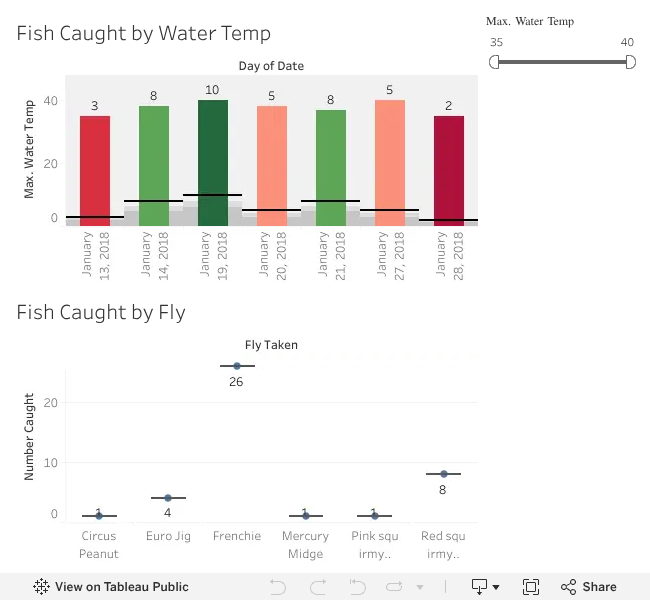
Today we're going to recap Sunday's adventure. It's more of a tale about persistence and beauty than it is catching the data and subsequent fish. We'll do all the normal rundowns in terms of our atmospheric data and fish caught (yes, we still netted fish). Last, we're going to do something I promised last week - we'll give you a dashboard on fly selection for Spearfish Creek Browns. In addition, we've got a little data on the importance of water temperature.

Atmospheric Apocalypse

Looking at the weather and stream data, one should not be surprised that fish were tough to come by. As mentioned above, air temperature hovered between 15 and 17 degrees. Humidity was high as the snow continued to fall and turned the beloved Black Hills into a sea of white. I could spot fish in the creek, and it was clear they were in a serious holding pattern. Sitting in a couple distinct water columns, I knew my drifts had to go down the stream without a hitch. We'll get more into the importance of a good drift as we delve further into the series, but for now....just know you need a good one - that's not a total drag :). At any rate, I waited to test the water temperature until after I netted the first fish. Upon a successful release, I took a reading. 35 degrees was the water temperature. Thank god for snow pants and smartwool socks. Because for you greenhorns out there, 35 degree water is enough to put your body through a serious condition in short order. In other words, respect the water and its temperature. Not doing so could end your fishing day, and in some waters, your life. Needless to say, the weather was miserable. And for the first time in a while, I was pleased to hop out of the water and run errands for my wife. There is something to be said about the majesty of a new-fallen snow on the tall hills once inhabited by the Lakota in our sacred Black Hills. The way the big flakes kiss the earth and fill the streams offers a fresh perspective as to why we're here. All we have is time, and seeing things like this is what drives me as a fisherman.

Net Results

In the 180 minutes spent on the water, we pulled in 2 fish. Yes, 2. That's it. That's all. End of story. Or is it? This is a really good spot to segue into the dashboard - which really focuses on the importance of water temperature. We'll get to that in a minute. The couple fish I managed to put in the net weren't bad fish. The first, which had a very subtle take - measured at 16". This is a good fish for this section of Spearfish Creek. Our second fish was a shade over 14". So, while not surprised at having to work for the fish - I was pleased with the result. Both eagerly took a Frenchie I tied up. This is a special fly to me because of the color scheme. The collar of the fly is chartreuse in nature. So, it screams as it descends into the Brown Trout stomping grounds. Fish seem to dig it. Again, I stray from the point. The weather, lack of bugs on the water, and the generally terrible weather told me it was going to be slim pickins on Sunday. In the end, I had a great time....until I didn't :).

Data Dig

The charts below are going to shed some serious light on the importance of conditions when you're seeking to put fish in your net. Seriously, the data don't lie.

I want to first focus on the water temperature piece. Notice a trend here? Sure you do. Even though the sample is limited at this juncture, a distinct pattern of information is emerging as an important factor in how many hook-ups you're getting on the water. There is a certain evolution in fisherman, and it goes like this. First, it's just good to be out. Then it transcends into number of fish caught. From there we travel to being a "size king". We conclude at, "it's good to be out." I'm at a pretty adventurous stage in my fishing adventures. Ok, back to the point! 5 fish netted when the water dips to or below 35 degrees. 36 fish were caught when water temperatures were 37 or above.  LIGHTBULB! So, all those warnings about water temp being important are true? Get outta town! Yeah, they are. And the data are telling you so.

Okay, the other thing you need to realize by looking at this dashboard is the fly selection. I'm no Tom Rosenbauer. In other words, unlike some, I don't fiddle with fly selection a lot. Taking the advice from Fly Shop bums passed on many moons ago, "fool with your rig first." Adjust depth and weight multiple times before messing with your flies. Now, this is probably personal opinion, but I think the results show I can be successful using a really basic setup. Approximately 65% of the fish I've caught over the the last few trips...were caught on one pattern. Another 22% were taken on another pattern. I've had great success keeping it simple. Bottom line, know what is on the menu for fish; however, know where they are sitting in the water. This enables you to toss pretty much any menu item at them....and pass it by in a way that they can't refuse it. Trout are opportunistic feeders, it's up to you to create the opportunity. It's the guy, not the fly sometimes.
I'll drop a video on one of Sunday's catches later in the week, but we're going to sign off for now.


Keep 'em wet,
MB

Saturday, January 27, 2018

01/27/18 - Back in the Saddle Again!

It's been a little while since we last updated. And while I promised an update that was data focused earlier in the week, I dropped the ball. Hey, life happens, and the job that pays our bills took front and center. We are back at it this week. I needed some serious stream time after a crazy week with kids and work. So, what should we cover today? Well, I'm glad you asked. I want to focus on a couple different things. First, I want to go over the stream and environmental data we collected during the trip today. Second, I want to alert you to a really cool site that inspired me to start collecting data and building an actionable set to work from. It's always easier to work backwards through your data to figure out how to solve your stream-related problems :)

Stream and Weather Data

I try to pay close attention when it comes to happenings above and below the water. We'll get more into the underwater piece of things once my seine arrives in the mail. For those who do not know, a seine is a tool to collect invertebrate samples from the various streams I'll fish. As Peter Stitcher says, "it helps us define what's on the menu." At any rate, I digress. The car said the air temp was 44 degrees when I parked it at around 12:45 pm. Once I got to the first run, I realized the car was lying. A quick check of the weather app indicated it was about 34, and the temp was dropping steadily. We had ample amounts of sun today, but the wind rode along with it - essentially zapping any warmth that we'd get. So, it was no surprise that when I tested water temperature, it was a warmer 40 degrees. I knew we'd be playing around with active fish since the water temp was nice. Also, with some clouds passing in and out, I knew there was a chance for some top-water activity. Sure enough, in examining the banks, I noticed midges popping off in clusters. These were tiny little clusters, probably a size 22 or smaller. Jinkies! It's our first clue. Okay, timeout. When you're seeing activity on the top, it's telling you a couple things. First, there's a hatch happening (or it happened). The second thing it tells you is.....(drum roll please)....where the fish might be in the water column. If you aren't seeing them sipping bugs off the surface, they could be keying in on emergers. During this time of year, a wd-40 is a great "catch all" based on these observations.

Today's Yield

Given the information above, I probably shouldn't have even rigged an articulated streamer. But guess what? I like a big bite, and a brown trout doesn't turn down a free lunch. I hooked up with my first fish a little after 1:00pm. It was a small brown, but he smashed my Circus Peanut with the savagery of a much larger fish. That's what I like about the streamer bite - it's pure aggression. Over the next couple of hours, we hooked up with fish in different sections of the creek with good regularity. In all, I was averaging a fish about every 20 minutes. Not bad considering the weather and air temp. We only had one take the streamer. The rest of the fish feasted on the euro style nymphs. There's something to be said about the versatility of those patterns. They mimic a myriad of insects in different stages during their life cycle. Remember in 8th grade when you first started learning about probability? Ok, the euro nymphs are a good lesson in this. If these patterns are imitating a number of invertebrates that are on a trout's dinner plate, the chances of you catching the fish.....you got it, it's greater. Don't get me wrong, it's not as simple as that. There are certain things one must do in order to effectively catch fish on a consistent basis. However, this is a good starting place.

Want an Inside Track? Check these resources out!

As I mentioned in previous posts, I've always been data driven. I've applied that to fly fishing quite a bit. It's enabled me to have a lot of fun on the stream. Apparently there are others who think like I do. That brings me to my point. I have a good resource for everyone who is interested in turning their fishing trips into an all out tactical war on the salmonids. The websites I'll tell you about are run by the same guy, Peter Stitcher. He's an aquatic biologist, and is way qualified to be dropping bug knowledge on people The first site, Ascent Fly Fishing, is focused on delivering flies to you that work for the areas you are fishing. In fact, their database is so solid, Peter and friends can prepare a fly box for you that matches the the hatch on your local water by the hour. It's insane, and the flies are quality. You're paying a little over a buck a fly for stuff that is proven to be on the trout's menu that day. The only thing that can screw things up is you :). I buy flies from them on occasion, and I've been really pleased with the product. The second site, which is more educationally oriented, is called River Oracle. They specialize in scientific tools and tutorials to help you become an amateur biologist on the stream. Seines, measuring tapes, thermometers, field journals, and many more products to help you decipher the stream's code.

Back on the water tomorrow. It's looking to be pretty cold....We'll leave you with a fish pic to close things out.


Keep 'em wet,
MB

Sunday, January 21, 2018

01/21/2018 - Take What the Water Gives You

This much is clear, sometimes during the winter, you're going to get blanked on a section that you normally catch fish. A section that you know holds fish. A section that you can sight fish in. It happens to all of us, and it happened to me in a particular section of Spearfish Creek today. No worries, I didn't go home empty handed. Today we're going to hit on a number of things. First, we'll go over the normal data collected from the stream and earth today. We're also going to hit on what to do when you're facing adversity. What separates decent fisherman from poor ones is their ability to persevere when facing finicky fish or other challenges handed to us by the outdoors. Let's get on with the data.

Areas Fished:

I ended up doing a decent amount of driving today. The first place we stopped was the City Park. This is an area that sees a ton of pressure from people in general. Ocassionally, you'll see people fishing. However, the creek also gets a ton of people floating and using it for recreational purposes. If you're smart, you'll catch fish. From the park, we sped up through Spearfish Canyon (where it's normally 10 degrees colder). The Canyon waters in the winter are fantastic. The tourist crowds clear out, and you pretty much have the entire Canyon to yourself. Last, I headed back into town and tested the waters around Highway 85. Stretches along 85 are pretty productive, and there are a number of areas where you have the possibility of hooking into a 20+ fish.

Weather and Water:

Friday was warm. Saturday was cooler. Sunday was the coldest. When I got on the water, the air temp was hovering around 33 degrees. In the Canyon, we measured air temp at 28. Although there were slight differences in air temperature, the water was fairly consistent throughout the stream. I measured 37 and 38 degrees when traveling to different spots.

Fly selection:

I switched it up a little today (and lost a few flies). The rig rundown was the same, but I ran a Euro Jig on the leader, and from there it varied between a Frenchie and a Squirmy worm. Are you noticing a trend with my fly selection? I'll post some data tomorrow, and it will shed light on my fly selection. Essentially, I'm going to tell you exactly WHY I haven't been switching it up.

Results:

So, I got blanked on a plunge pool at the park today. Fish were a bit finicky, but it was more the fisherman that was the issue. I'll be frank in saying I was a bit lazy with my drifts and mends (How to mend fly line). Also, the fish were half-assing it when it came to takes. They'd half-way take the fly and release before a hook set. Feeling a bit frustrated, I packed up and headed towards the Canyon. Boy, am I glad I did. Immediately, I was railing fish left and right. All I needed was a little break and a good drift. The fish weren't large, but I got into a mess of 'Bows. There were a few Browns in the mix, but we were mostly jamming with Rainbows. After my feet were utterly frozen, I headed back to town to try one last hole on the 85 stretch. I hooked up with a couple and landed one in t he last 30 minutes of fishing. We put quite a few in the net for a cooler day, and I have to say, I'm pleased with the results. 

A Note on Adversity:

When you're facing adversity, keep at it! Here's a series of things I do....way before I change flies.

1. Take a break. Sometimes it's necessary to cool out. You know, before you get so angry that you snap a rod over your knee.

2. Fiddle with your tippet length, your indicator, and the amount of weight you're using. Always, always, always adjust this stuff. You might not be sinking fast enough. You might not be deep enough. Think through these variables before ever switching flies.

3. Have fun. You're there to have fun. So, just relax. I do this blog because I want to encourage people to have fun. Yes, I catch fish consistently. Yes, I have tough days on the water. Yes, I still tangle up in trees. Yes, I'm having fun. Fly fishing doesn't pay my bills. I go to rivers and streams to heal what's wrong inside of me. Trout streams enable me to be more patient, focused, and loving to those who really matter.

The Media:

Here's a couple snaps from today. I forgot the SD card for the camera. So, we get phone pics today.


Keep 'em wet,
MB